


SEB: Achieving WCAG 2.1 AA Through User Research
When SEB Pank approached our team from Tallinn University, they had a specific business need: to get a neutral assessment of how well their internet bank met web accessibility standards (WCAG). The European Accessibility Act was approaching, but the bank didn't have a clear understanding of where to start and what specific barriers their clients were experiencing.
In 3 months, we didn't just conduct an audit—we built a comprehensive research methodology that gave SEB concrete insights about their users and a clear action plan.
The Challenge: From Compliance to User Understanding
SEB knew they had to meet legislative requirements, but this didn't answer the main question: what specific problems do their clients actually experience?
An additional complexity: due to legislative restrictions, the bank couldn't store information about clients' disabilities. This meant there was no data to analyze, and recruiting users for research was practically impossible.
We needed to find a way to study real user experiences without having direct access to the target audience.
Methodology: Combining Data Sources
We proposed an approach that combined multiple data collection points to create a complete picture:
1. Technical Audit as Foundation
We started with the basics—checked the site for WCAG 2.1 compliance:
Manual testing using the A11y Project checklist
Automated checking with WebAIM WAVE tool
Color contrast testing using WebAIM Contrast Checker
This gave us a list of specific technical problems: insufficient contrast in brand colors, markup errors, navigation issues.
2. Insights from the Front Lines: Focus Groups with Support Teams
Customer support agents are people who hear about user problems every day. We conducted two focus groups (Tartu and Tallinn) to understand:
What difficulties clients most often contact them about
Which user groups need the most help
What behavior patterns they notice
Result: We discovered that elderly users are the most vulnerable group, while actively using the internet bank. After the UI update in 2023, many of them experienced technostress. If they can't figure it out—they go to a bank branch, which creates additional operational costs.
3. Field Research: Conversations with Real Users
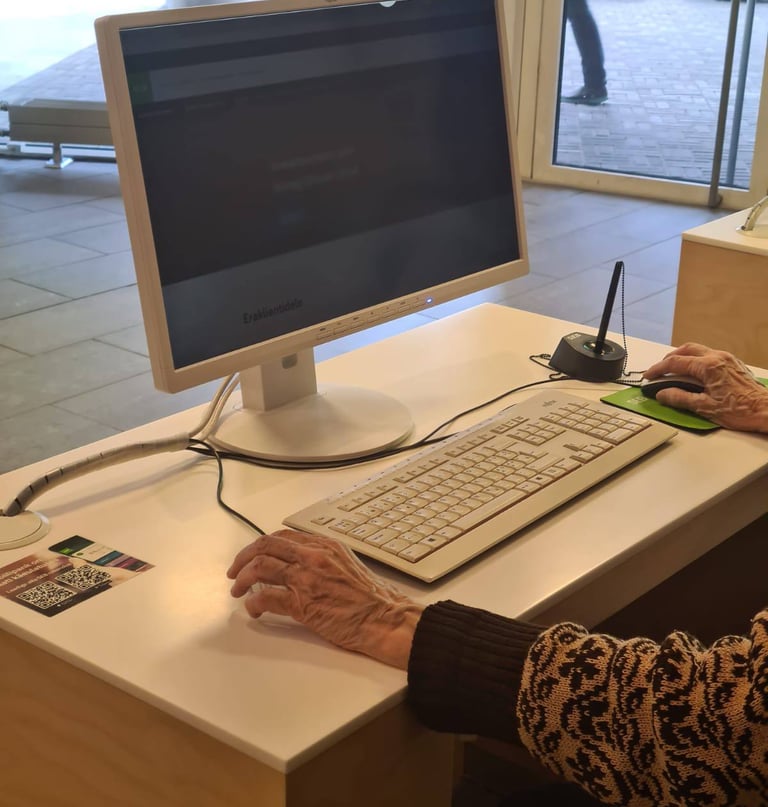
Recruitment was challenging, but we found a creative solution—we went directly to bank branches. We conducted an in-depth interview with a client who regularly uses the internet bank and spoke with other visitors.
Unexpected insight: People in branches are precisely those who DON'T use online services. But this also provided valuable information—we learned why they refuse digital channels (low digital literacy, lack of motivation, fear).
Additionally, we used snowball sampling and conducted an interview with a user from a rural area who uses an iPad to pay utility bills.
4. Synthesis: From Data to Persona
Based on all collected data, we created the persona Karoliina—not an abstract image, but a compilation of real SEB client characteristics:
74 years old, former accountant
Early macular degeneration, arthritis
Has used internet banking for 10+ years but experiences difficulties
Comfort level with technology: 5/10
Main values: security, simplicity, predictability
This persona gave SEB a concrete face of their typical user with special needs.
5. Customer Journey Map: Where Exactly Problems Arise
We detailed the money transfer process and overlaid it with:
Technical audit results
Focus group insights
User emotions at each stage
This allowed us to precisely identify the critical point—the payment form, where the most barriers were concentrated.
Solution: From Insights to Design
Having a clear understanding of the problems, we prioritized through brainstorming:
Content — the most important factor that consistently surfaced in research
Security and trust — critical for elderly users
Visual cues — to make it clear what's clickable
Simplified navigation — less cognitive load
We created wireframes, then a full design based on SEB's existing design system (fixing accessibility issues in components), and tested with real users.
A/B testing showed that the simplified menu worked significantly better—the user chose a visible tab instead of a hidden button.
Business Results
Compliance: SEB achieved WCAG 2.1 AA standard compliance—all critical errors eliminated.
Deep User Understanding: Instead of abstract legislative requirements, the SEB team gained concrete understanding of their audience's needs and how technical accessibility problems translate into real barriers in user experience.
Methodology for the Future: A structured research approach that can be applied to other products and features.
Reduced Operational Costs: Better accessibility of online channels means fewer visits to branches and support contacts.
Key takeaways
Combine research methods. No single data source provides the complete picture. Technical audits show "what's broken," focus groups with support show "what concerns people," user interviews show "why it matters." Only together do they create comprehensive understanding.
Personas are communication tools. Karoliina helped the SEB team talk about accessibility not abstractly ("WCAG compliance") but concretely ("how Karoliina will transfer money to her granddaughter"). This shifts focus from compliance to empathy.
Accessibility isn't a technical requirement. It's a business opportunity to better understand your users and create an experience that works for everyone.


Diana Miftakhova
WCAGENTS Expert
+380 73 377 9824
info@wcagents.com.ua
Vulytsya Yevhena Sverstyuka, 2А, 608
BC Livoberezhniy, Kyiv
